
Plumbing Resource
What Size Water Heater Do I Need? Capacity, Household Demand, Fuel Type, and Space
Water-heater sizing depends on peak hot-water demand, delivery capacity, fuel type, space, and equipment requirements—not household size alone.
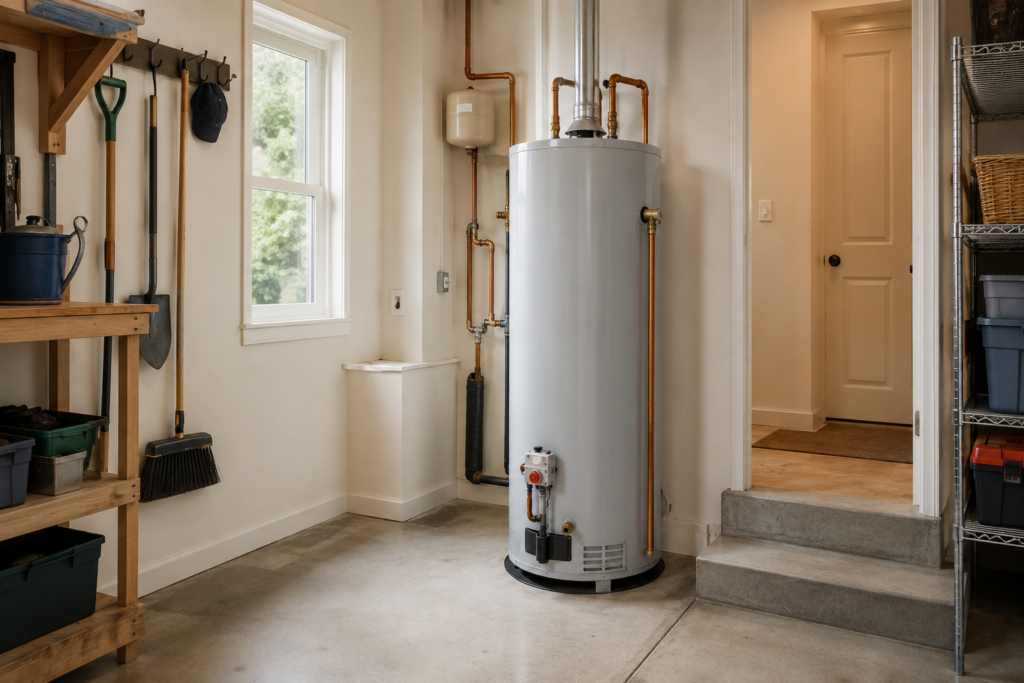
Water-heater sizing is often reduced to a chart saying “X people need Y gallons.” Two households with the same number of people can use hot water very differently, so a better discussion begins with peak demand and equipment delivery capability.
TANK CAPACITY IS ONLY PART OF THE PICTURE
For storage water heaters, gallons in the tank matter, but they do not fully describe what the household can receive during a busy period.
ENERGY STAR defines First Hour Rating (FHR) as an estimate of how much hot water a storage water heater can supply during an hour that begins with the heater fully heated. Recovery capability therefore matters in addition to stored volume.
THINK ABOUT THE BUSIEST HOUR
Consider how many showers happen close together, whether multiple bathrooms are used simultaneously, large tubs, laundry, dishwasher use, other hot-water fixtures, morning versus evening demand, and likely changes in household routine.
The purpose is not to calculate a perfect engineering model at home. It is to describe the demand the replacement needs to serve.
HOW IS THE CURRENT UNIT PERFORMING?
If the existing heater usually meets demand, note its storage capacity and any available performance information. If it has always run out of hot water, replacing it with another unit based only on the same nominal gallon number may repeat the same dissatisfaction unless peak demand is considered.
FUEL OR ENERGY SOURCE
Water heaters may use electricity, natural gas, propane, or another energy source. The existing source affects the connections and installation requirements available at the property.
Changing energy source can involve more than replacing the appliance. Gas, electrical, venting, combustion-air, circuit-capacity, and code requirements can vary, so confirm what work is appropriate and currently available for the property before choosing a different setup.
AVAILABLE SPACE AND ACCESS
A replacement has to fit the installation area while allowing the clearances, connections, drainage, venting or electrical access required by the selected equipment.
Measure or document the current unit and the access path rather than assuming any similarly rated model will fit. Different equipment categories can also have different site requirements, so use the actual manufacturer's installation information for the model being considered.
WHAT TO DOCUMENT
Gather the current unit's capacity, model number if safely visible, fuel or energy type, approximate dimensions, access path, household peak-use pattern, whether current capacity has been adequate, and photographs of the existing installation.
Do not remove panels or disturb gas or electrical connections to collect this information.
FHR IN PLAIN LANGUAGE
FHR is useful for comparing how much hot water a storage model can deliver during a standardized busy hour. It is not a promise that every home will receive exactly that amount at every fixture. Incoming-water temperature, setpoint, piping, household use, and installation conditions can affect real-world experience.
AVOID THE “PEOPLE EQUALS GALLONS” TRAP
Household size is a starting clue, not the entire calculation. A better question is: what does this household need during its busiest hour, and can the selected equipment deliver that demand safely in this installation?
PERMITS AND INSTALLATION REQUIREMENTS
Permit and installation requirements vary by jurisdiction, property, and equipment. Verify the current local requirements that apply to the actual replacement rather than assuming one rule covers every Huntsville, Madison, or Athens property.
Sources reviewed
Request Service
Call 1 725-745-6034Related Resources
Why Is My Water Heater Not Making Enough Hot Water?
Running out of hot water can involve demand, capacity, controls, leaks, sediment, or components. Learn what to observe safely before requesting repair.
Read the guide