
Plumbing Resource
What Builds Up in Kitchen and Bathroom Drains—and Why Does It Keep Coming Back?
Kitchen grease and food differ from bathroom hair and soapy residue. Learn what can build up, why symptoms may return, and how to reduce new deposits.
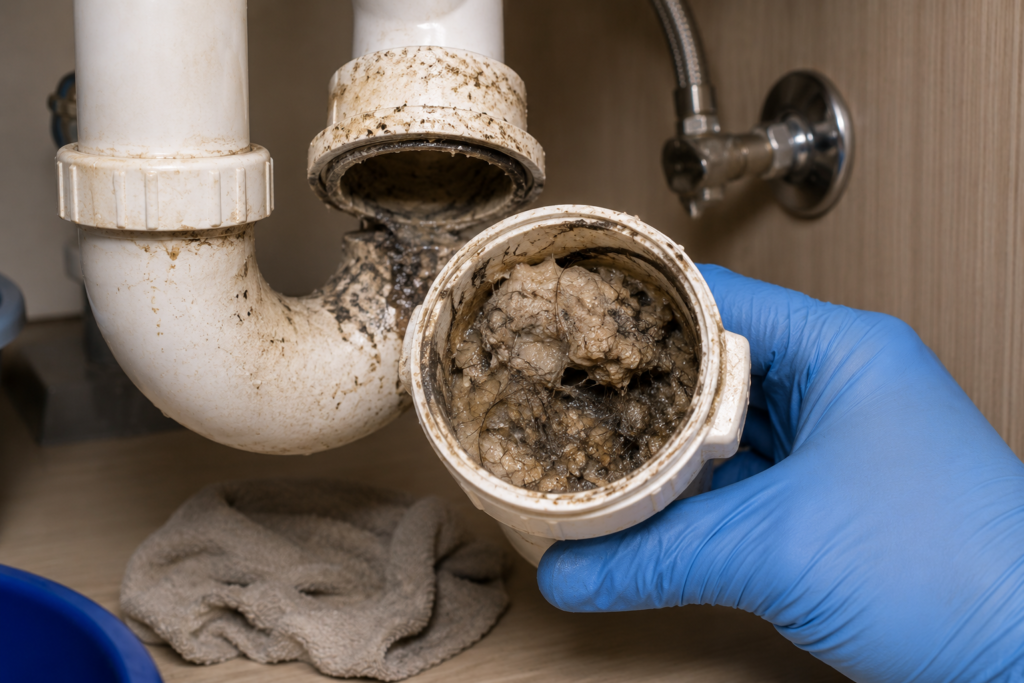
Kitchen and bathroom drains do not collect exactly the same material. That difference matters when a homeowner is trying to understand why slow drainage or buildup keeps returning.
The goal is not to label every slow drain as “buildup.” It is to understand what commonly enters each fixture, how new material can accumulate over time, and when recurring symptoms may point to something broader.
KITCHEN DRAINS: FATS, OILS, GREASE, AND FOOD
EPA wastewater guidance identifies fats, oils, and grease as important blockage contributors. Kitchen sinks also receive food residue, especially when dishes are rinsed before solids are scraped away.
A garbage disposal changes the size of food waste; it does not make the material disappear. Using a sink strainer, scraping dishes before rinsing, and collecting cooking grease for appropriate disposal can reduce how much new material enters the drain.
This is prevention of new accumulation. It does not tell you how much material is already inside the pipe.
BATHROOM DRAINS: HAIR, SOAPY RESIDUE, AND PERSONAL-CARE MATERIAL
Bathroom drains see a different mixture. Public wastewater guidance identifies hair, soaps, and other organic or personal-care material as things that can collect in drainage systems.
Hair is especially easy to capture before it enters a tub or shower drain. A simple screen or hair catcher can reduce new material going into the pipe. Following product directions and keeping wipes, paper towels, hygiene products, and similar items out of drains and toilets also reduces avoidable solids.
Again, prevention and removal are different questions. A strainer can reduce what enters tomorrow; it cannot confirm that an existing restriction has been removed today.
WHY CAN MATERIAL COME BACK AFTER A DRAIN WAS CLEARED?
There are two separate ideas that homeowners often combine:
- EXISTING ACCUMULATION: material already present may not have been fully removed, or the drainage path may have another condition contributing to poor flow.
- NEW ACCUMULATION: the same grease, food, hair, soaps, or other material can continue entering the drain after flow improves.
That is why a drain can seem normal for a period and then gradually slow again. The recurrence tells you the symptom returned; it does not by itself tell you whether the reason is remaining buildup, new buildup, a localized obstruction, or another plumbing condition.
PREVENTING NEW MATERIAL IS NOT THE SAME AS CLEANING EXISTING MATERIAL
This distinction is important. Good drain-care habits can reduce future input. They do not guarantee that an existing deposit will disappear, and this article does not prescribe one universal cleaning technique.
The appropriate method depends on the fixture, piping, type of restriction, access, and actual condition. Avoid repeatedly mixing drain chemicals or combining products in an attempt to “clean everything out.” Follow product warnings and seek service when symptoms keep returning.
A SIMPLE KITCHEN-VERSUS-BATHROOM CHECK
If the kitchen is the recurring problem, think about grease, food solids, disposal use, and what goes through the sink during cleanup.
If a shower or tub is the recurring problem, think about hair capture, soaps/personal-care residue, and whether the drain screen is collecting material before it enters the pipe.
If several unrelated fixtures slow or gurgle at the same time, stop treating the situation as a simple kitchen-or-bathroom buildup question. Multiple-fixture symptoms can justify a broader drainage-system evaluation.
WHEN TO CALL
Slow drainage that repeatedly returns, a drain that becomes fully blocked, backups, or symptoms spreading to additional fixtures are reasonable reasons to move from prevention toward evaluation.
Sources reviewed
Request Service
Call 1 725-745-6034Related Resources
Why Does the Same Drain Keep Clogging After Plunging?
If the same sink, tub, or shower keeps clogging after plunging, learn how recurrence patterns can help describe the problem before you call.
Read the guide
What a Sewer Camera Inspection Can — and Cannot — Tell You
Sewer cameras can reveal visible pipe conditions, roots, debris, offsets, and defects—but they have limits. Learn what camera inspection can and cannot establish.
Read the guide